For companies operating in highly regulated spaces: healthcare firms bound by HIPAA, financial services managing strict data sovereignty laws, or legal practices safeguarding attorney-client privilege, deploying AI isn't simple. Nor is it for other organizations who have requirements for: intellectual property protection, minimal latency, cost predictability, data residency, integration control. In this post, we wanted to examine the range of options for these organizations with particular requirements.
For comparison purposes, we’re considering a 100 employee company with a dedicated internal IT or engineering function with the following capabilities: DevOps, MLOps, security and platform engineering.
Those capabilities will be required to manage the higher tier options listed below. When evaluating how to bring generative AI into a company, you aren’t just looking at specific capabilities. You’re looking at a continuum that balances architectural control against total cost of ownership (TCO).
To help guide your strategy, here is the enterprise AI deployment spectrum broken down from the most expensive option to the least expensive, based on the operational realities listed above, with approximate costs as of this writing.
The AI Deployment & Governance Spectrum
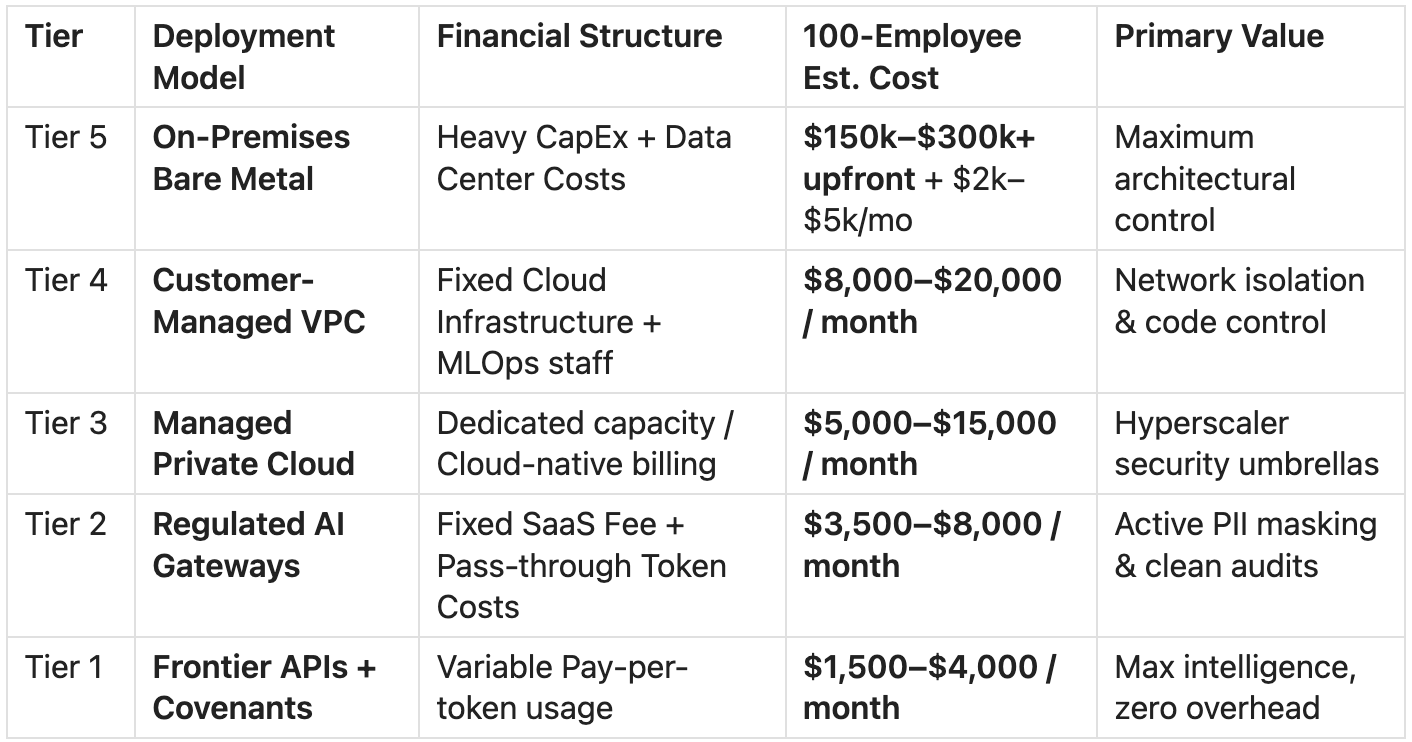
On-Premises & Air-Gapped Bare Metal (Most Expensive)
The Concept: You bypass the cloud entirely. Your company purchases physical hardware, installs it in a private corporate data center, and runs open-weight enterprise models on bare metal.
For a 100-employee company, this means buying specialized, high-bandwidth memory server architecture or specialized hardware arrays capable of running large models locally.
The Trade-offs
- Pros: Maximum architectural control and data residency assurance. Data security is protected by physical locks, building security, and internal firewalls. Potentially eliminates reliance on external cloud subprocessors.
- Cons: Enormous capital expenditure (CapEx) barrier. Long procurement lead times, physical maintenance overhead, and a rigid ceiling on computing capacity. If your staff outgrows the hardware, you have to buy more servers.
Estimated Cost Profile: Low six figures to substantially higher CapEx depending on redundancy and performance requirements, plus $2,000 to $5,000/month for data center power, cooling, and ongoing system maintenance.
Self-Managed VPC (Self-Hosted Cloud)
The Concept: You rent the raw iron from a cloud provider (like AWS, Google Cloud, or Azure), but your engineering team completely owns everything inside the perimeter. You provision your own virtual private cloud (VPC) compute instances and deploy containerized, open-weight models.
The Trade-offs
- Pros: Complete logical autonomy over your data pipeline. The cloud vendor provides the virtualization layer but does not typically have application-layer access to your workloads or data. You can fully customize fine-tuning pipelines, and guarantee to auditors exactly where every bit of data resides.
- Cons: Heavy operational engineering overhead. Your team is fully responsible for building and maintaining the inference infrastructure, managing high availability, and handling cold-start latency mitigation.
Estimated Cost Profile: $8,000 to $20,000/month. This is driven by fixed cloud GPU reservations coupled with the specialized DevOps/MLOps engineering hours required to keep the system performant.
Managed Private Cloud (VPC-as-a-Service)
The Concept: Instead of managing raw servers in the cloud, you use a cloud hyperscaler's specialized native AI framework (such as AWS Bedrock, Google Vertex AI, or Azure OpenAI dedicated instances). The infrastructure is managed by the cloud provider, but the models run within dedicated or logically isolated environments.
The Trade-offs
- Pros: Seamless integration with existing cloud storage and enterprise architecture. Your AI workloads instantly inherit the hyperscaler's broader compliance portfolios (SOC 2, ISO 27001, HIPAA, or FedRAMP). Data routes through private networks, bypassing the public internet.
- Cons: Direct vendor lock-in. You are constrained to the specific models, pricing updates, and infrastructure limits of whichever hyperscaler ecosystem you build upon.
Estimated Cost Profile: $5,000 to $15,000/month. Cloud providers typically charge for this via provisioned throughput—meaning you pay a baseline hourly rate to keep specific GPU capacity warm, regardless of how active your 100 employees are.
Regulated Intermediate Vendors / AI Gateways
- The Concept: Your team uses public frontier models, but an intelligent compliance software layer sits between your employees and the internet. Using proxy gateways, data leakage prevention overlays, secure AI brokers and AI governance layers, you can actively intercept outbound data, automatically stripping, tokenizing, or masking PII and protected health information before requests hits the public API endpoint. These systems reduce, but do not completely eliminate, compliance and privacy risk. Inference outputs can still leak sensitive patterns, prompts may still contain contextual identifiers, re-identification risk remains.
The Trade-offs
- Pros: Allows a mid-sized team to leverage the top-tier intelligence of public frontier models without exposing raw regulatory data. Provides centralized auditing, access controls, and clear logging for compliance officers.
- Cons: Introduces minor application-layer latency. Tokenization algorithms are not always flawless; highly complex or unstructured narratives (like messy legal depositions or medical charts) can occasionally lose crucial context during the masking process.
Estimated Cost Profile: $3,500 to $8,000/month. This is structured as a predictable platform SaaS fee (typically $2,000–$5,000) combined with the variable, pass-through token costs of the underlying models.
Frontier APIs with Enterprise Covenants (Least Expensive)
The Concept: You connect directly to public endpoints hosted by major AI providers (like OpenAI, Anthropic, or Microsoft) over standard encrypted HTTPS. Security and privacy is governed entirely by legal paper: custom Business Associate Agreements (BAAs), and provider-specific enterprise agreements that may include zero-retention and no-training provisions.
The Trade-offs
- Pros: The lowest possible barrier to entry. You get instant access to state-of-the-art frontier models with zero infrastructure management, sub-second scaling, and a purely usage-based cost model.
- Cons: You are relying entirely on contractual compliance rather than architectural isolation. Data does leave your corporate perimeter to be processed on shared multi-tenant cloud environments. A single software misconfiguration on the provider’s end introduces compliance risks.
Estimated Cost Profile: $1,500 to $4,000/month. Assuming a 100-person firm with heavy production usage (roughly 5 to 10 million tokens consumed per day across the organization), you pay strictly for what you use. Typical knowledge-worker usage may be substantially lower.
Finding Your Total Cost of Ownership Inflection Point
For a 100-employee company, the choice often comes down to a clear financial and operational inflection point:
- When to stay low-cost (Tiers 1 & 2): If your primary goal is giving staff access to standard productivity tools, drafting assistance, or basic workflows, the legal protection of an Enterprise Covenant or the software masking of a Gateway provides the best balance of safety and low financial friction.
- When the cost is justified (Tiers 3, 4, & 5): If your core product relies on processing massive volumes of deeply sensitive, proprietary data (such as high-throughput automated medical coding or thousands of legal discovery files), the token fees of public models will skyrocket. At that scale, moving to a private cloud VPC or local hardware provides a double benefit: absolute architectural sovereignty and a predictable, fixed infrastructure cost.
All that being said, while the above tiers have been presented as distinct options, in practice, many organizations operate across multiple tiers simultaneously depending on workload sensitivity, latency requirements, and cost structure.